FROM VAUGHAN
I Go, You Go
Viennese Waltz frightens a lot of dancers. It's fast, it turns constantly, and it looks like two people spinning like a dish.
But Ballroom dancing is a giant illusion. What you think is happening usually isn't.
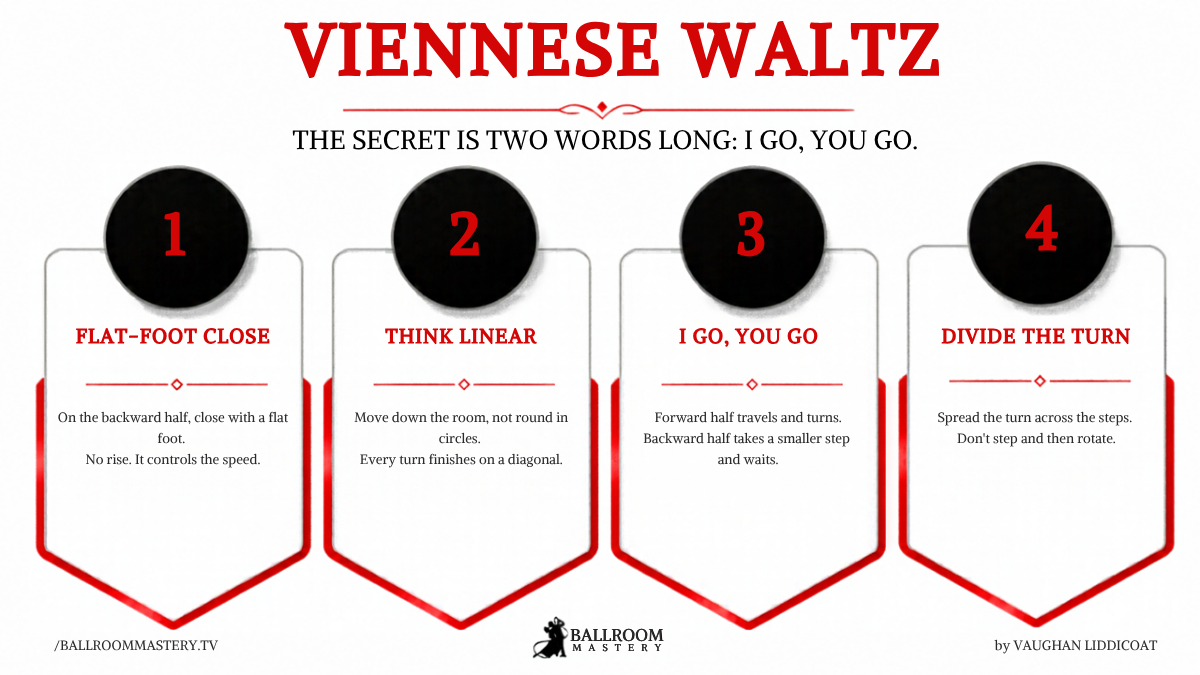
The Viennese Waltz isn't really a spinning dance. It's a linear dance, like the Foxtrot. You move down the room, and the turn is divided up across the steps. You don't step and then rotate.
And the most important idea is one I call I go, you go.
Whoever is on the forward half of the turn goes. Whoever is on the backward half takes a smaller step and lets their partner come around them. Then you swap. I go, you go. I go, you go.
Most couples get this wrong. Both partners push, both take big steps, and they fight each other the whole way round. It isn't the speed that makes Viennese Waltz hard. It's energy in the wrong place.
So tell me: does your Viennese Waltz feel like a dance or a wrestling match? Hit reply. I read every one.
Vaughan
P.S. Members get the full three-tip breakdown below, including the flat-foot close that controls the speed. Join here to unlock it.
"Ballroom dancing is a giant illusion.
What you think is happening isn't really happening."
This Edition's Tutorial

3 Tips to Master Your Viennese Waltz
Problem: Your Viennese Waltz feels rushed, you overshoot the turns, and you and your partner end up fighting each other.
Promise: Three principles that even top competitors forget, so the dance feels controlled instead of frantic.
MASTERY MEMBERSHIP
Ask Vaughan's Genie Anything
When you and your partner end up fighting each other through the turns, don't wait for your next lesson. Open the Mastery Genie and type:
"Why do my partner and I fight each other in Viennese Waltz turns?"
In seconds you're watching my answer, pinpointed to the exact second, with lessons like Viennese Waltz Next Level: Reverse Fleckerls to fix it today.
$97 a month. Cancel anytime.
When members practised the same figure at slow, medium and full speed, they found speed exposes what technique is actually doing, not what we think it's doing.
Mastery Member Insight.